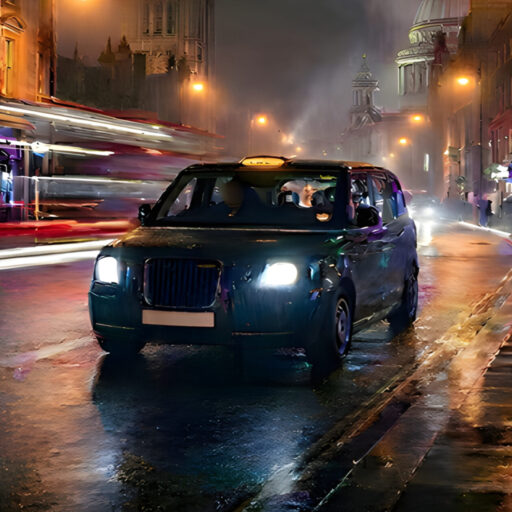
What Is The Knowledge of London Taxi Test? A Straight Answer From Someone Who Lived Beside It for Nearly Twenty Years
The short answer: The Knowledge of London is the qualification you have to pass to drive a licensed black cab in the capital. It is not an exam you sit in an afternoon. It is a process that takes most people between three and six years, done on a moped in all weathers, and the only way you can truly fail it is by giving up. Plenty do.
I know that because I ran taxiknowledge.co.uk from the late 1990s until 2016. At its peak the site was doing a million hits a day and got featured in the local paper. It started out supplying points, 320 up to date runs, map software, blue plaques, hotels and embassies, and once the internet caught up I built a full shop so students could download everything instantly. I have no exact count of how many people used my material over the years, but it ran into the many thousands. Just as importantly, this is a family trade for me. My brother did the Knowledge. So did other relatives and friends. One of the people who fed me runs and points in the early days was on his 21s at the time, so I have watched this machine work from the inside, not read about it.
So let me tell you what it actually is.
The Blue Book and the 320 runs
Everything starts with the Blue Book. Despite the name it is really just a list of runs, point to point, all across London. Something like “Manor House to Gibson Square.” The idea is simple to describe and brutal to complete: you run each route, work out the shortest way, then move on to the next one. Do that 320 times.
Over the years students began writing the runs down exactly as they should be driven, along with how to call them over. Once you had a full set of correct runs, you could sell them, because a completed run saves the next Knowledge boy or girl the time of working it out from scratch. That is essentially what my site did at scale.
What “calling a run” actually looks like
This is the bit outsiders never see. You do not describe a route in plain English. You call it in a set format, road by road, turn by turn. Here is Manor House to Gibson Square called properly:
- Leave on left Green Lanes
- Right and right Highbury New Park
- Left Highbury Grove
- Right Saint Pauls Road
- Comply Highbury Corner
- Leave by Upper Street
- Right Barnsbury Street
- Left Milner Square
- Forward Milner Place
- Forward into Gibson Square
That is the language of the Knowledge. Every run, every appearance, gets called like that. Multiply the discipline in those ten lines by 320 runs, then by every possible combination of start and finish across the city, and you start to understand the scale of what you are taking on.
The appearances: 56s, 28s, 21s
Once you have completed the 320 Blue Book runs, you go on the appearances. That word means exactly what it says. You appear in front of a Transport for London examiner, and they ask you to take them from A to B. A and B can be anywhere inside the six mile radius. You have to give the shortest route and call it in the format above.
The stages are named after the number of days between each appearance:
- 56s. You appear every 56 days until you pass this stage. When you first start it can be intimidating, but the examiners know that, so they tend to be a bit more lenient with you early on.
- 28s. You move up to appearing every 28 days.
- 21s. Finally every 21 days.
The intervals shrink as you progress, so the pressure builds rather than eases. Pass enough appearances at each stage and you move up. That is the ladder.
How long it really takes
Realistically, three to six years for a green badge. Some sharp students might do it in around two. Some take longer. Anyone promising faster than that is selling you something, which brings me to my first strong opinion.
A lot of Knowledge schools will tell you that you can finish in a year using their materials, their school and their methods. That is a sales pitch, plain and simple. The chance of getting a green badge inside a year is practically zero. I am not aware of anyone who has ever done it in that time. A yellow badge in a year, maybe. A green badge, no.
And this is the heart of it: the only way to fail the Knowledge is to quit. Nobody boots you out for being slow. You beat yourself. Which is why so many people never finish.
Green badge versus yellow badge
People use these terms loosely, so let me pin them down, because the difference is significant.
The yellow badge is the easier and quicker one to get. It covers certain suburban sectors, so there are fewer runs to learn and less material to buy. But it limits you. With a yellow badge you can only work the suburbs, and only the sector you have chosen. You can pick up a customer in your sector and take them into central London, but then you have to drive all the way back to your sector before you can pick up another fare.
The green badge gives you the lot: all the sectors plus central London. You can pick up at Buckingham Palace, drop at Greenwich, then pick up someone in Greenwich who wants Trafalgar Square, and keep working wherever the fares take you. That freedom is the whole point, and it is why the green badge is the badge to have.
That said, a lot of students do the yellow badge deliberately. It gets them earning sooner, and they carry on working towards the green while money is coming in. It is not a lesser choice if you use it that way. It is a sensible one.
The human cost, and what the badge gives back
I want to be honest about what this does to people, because the brochures will not tell you.
The biggest thing that pushes people to quit is the strain on relationships. A partner is usually keen and supportive at the start, but that rarely lasts. If the student is working as well, they are hardly ever home. They work, pop in briefly, then go straight back out doing runs. Many use their partner to call over with, which means reciting the same runs again and again. It is repetitive and boring, and frustration creeps in fast, especially because the partner usually has no idea about the runs, so if one gets called wrong, they will not even know.
Then there is the money. The medical, the materials, the moped, it runs into many thousands of pounds, and there is no financial help from anywhere. None.
There is a mental strain too. It is genuinely frustrating when you cannot find a street or a point. And the hours are punishing. It is easier to go out late at night or early morning when the roads are clear, but that brings drunks, drunk drivers and the risk of being robbed into the picture.
Now the other side. My brother completed the Knowledge working part time. Once he had his green badge, the freedom it gave him was amazing. His wife wants a holiday, he goes out and does a fourteen hour shift and the money is there. The washing machine breaks, he goes out for a few hours and buys a new one. Being his own boss was the big thing for him. Nobody telling him what to do or where to go. Nobody telling him he had to work five or six days, be in at a set time and leave at a set time.
A friend of mine used to set himself a target for the day, and once he hit it, he went home. That is the life it buys you. And all those long hours, scary nights and days out in filthy weather soon become distant memories. That is the trade the Knowledge asks of you, and that is what it hands back.
How you actually study it (the practical bit)
Studying is an individual process. What works for one person will not necessarily work for the next. But there is a right way and a wrong way to start.
If you do not work from a proper set of Blue Book runs, you will just ride around like a headless chicken. The Blue Book runs give you the actual route, and most come with points of interest at the start and end. Work through them.
Now, a myth to kill. Nobody sits at home laying a piece of cotton on a map to find the quarter mile radius between two points. That work has already been done. When you buy the completed runs, you have them ready. You could do it the proper old school way, working every route out yourself from a bare list, but you would be wasting an enormous amount of time. You could also just buy the Blue Book as a list and figure out every route yourself, if you enjoy pain.
My other piece of practical advice goes against what a lot of people do: forget the points, at first. A lot of students get fixated on hunting for points and waste huge amounts of time. Here is the thing. As you progress, you are riding up and down the same streets every single day. Out of sheer boredom you start noticing the points, and they stick on their own. Then, once you have completed all the runs, you go out “pointing,” which is going round purely to find points and bank them. Seeing a point written on paper is not the same as seeing it for real. Get the runs into your legs first, and let the points come.
What people get wrong about the Knowledge
“Sat-nav has made it pointless.” Sat-nav is a great tool, but it is not built for a working London cabbie. Picture a client in the back and a traffic jam ahead. Every sat-nav in the area reroutes everyone to the same “fastest” alternative, and it does not take long for that road to jam as well. A cab driver knows a better work-around and avoids the lot. That local judgement is exactly what the Knowledge builds, and no app has it.
“Uber killed the black cab.” Uber was a quick fix for anyone who wanted to drive a minicab in London and earn fast money. But minicabs cannot be hailed. They only get booked work. When it suddenly starts raining in London, and it does that a lot, people just want to stick their hand out, get a cab and jump in. They do not want to open an app and wait for a driver to become free. On top of that, every black cab driver passes a police check, so passengers can trust them, and the badge is on show at all times so you know the driver is legitimate. Every black cab also has a wheelchair ramp fitted. That is not optional, it is mandatory. Minicabs are a different proposition entirely.
“It is just memorising a map.” No. It is judgement under pressure, built over years, tested live in a room by an examiner who can send you anywhere to anywhere.
Is it still worth doing in 2026?
Yes, if you have the determination and the self discipline. But weigh up everything involved, especially the time.
Here is something worth knowing. My site closed in 2016 partly because fewer and fewer people were doing the Knowledge, because they thought Uber was the way forward. A lot of them found out the hard way that it was not the time-saving solution they had hoped for. By then they had wasted a year or two discovering that, which left them one or two years behind where they would have been if they had just started the Knowledge.
The good news for anyone thinking about it now: more and more people are starting the Knowledge again. The trade is alive and kicking. And with fewer drivers on the road, the competition is probably lower than it has been in more than twenty years. If you have got what it takes, that is an opportunity.
Final word
The Knowledge of London is one of the hardest qualifications you can take on, and one of the few where finishing is entirely down to you. Nobody fails you. You either keep going or you stop.
If you are seriously considering it, do your homework before you spend a penny on a moped. I have written a book that gives you all the advice you need to make an informed decision about whether the Knowledge of London is for you, green badge or yellow. Buy it and it will either save you money or make you money. Either way it is a wise investment before you commit years of your life to this.
And remember the one rule that governs the whole thing: the only way to fail is to quit.
Leave a Reply
You must be logged in to post a comment.